What exactly does “fractional” mean?
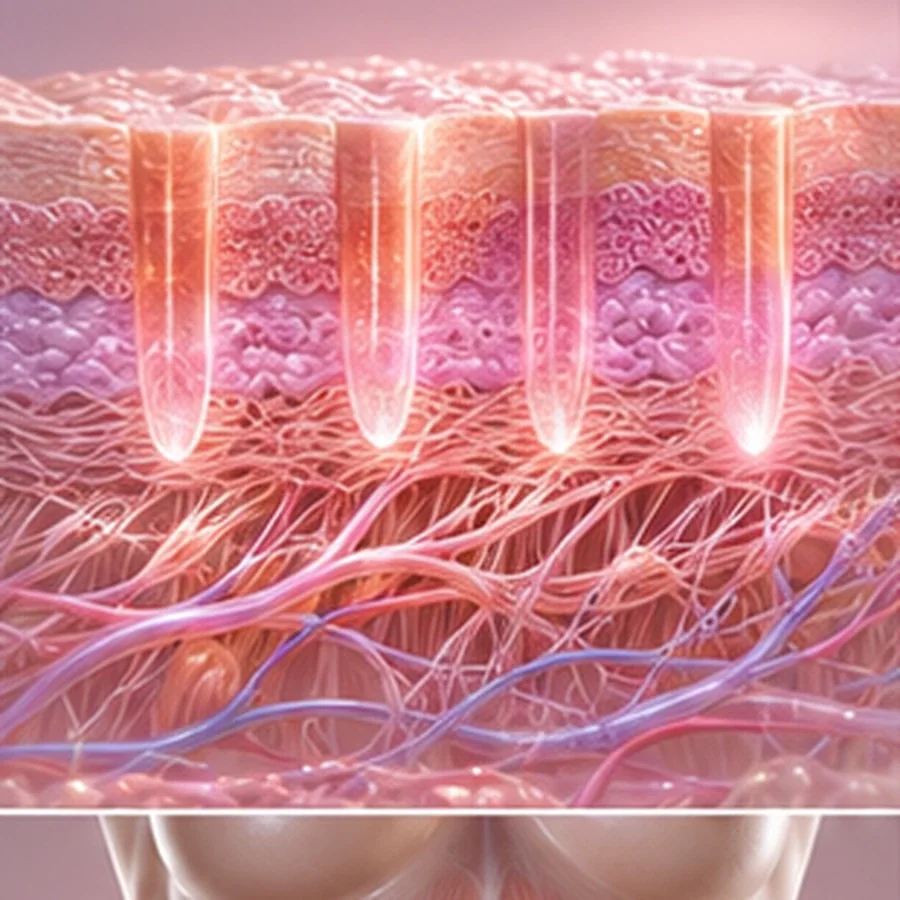
Instead of treating an entire area uniformly, the device distributes energy into microzones. Between them, portions of skin not directly treated contribute to recovery.
Read a related treatment pageTreatment microzones, collagen, healing, and results: understanding fractional laser without technical jargon.
A laser that treats skin in small spots rather than over its entire surface: this is the principle of fractional laser treatment. This technology often raises questions because collagen, remodeling, and skin renewal are mentioned without always explaining what actually happens.
GYNEBELLE / MEDICAL NEWS / ARTICLE 001
01 / UNDERSTANDING THE SUBJECT
A laser that treats skin in small spots rather than its whole surface: this is the principle of fractional laser. This technique often raises questions because people talk about collagen, remodeling, and skin renewal without always explaining what actually happens.
For acne scars, surgical marks, or certain textural irregularities, the approach may be helpful. But skin is not a material that can be smoothed at will: healing capacity, pigmentation, and medical history matter as much as the technology itself.
At GYNÉBELLE in Ennasr 2, Ariana, the fractional CO₂ laser is among the devices presented for certain skin indications.
Unlike uniform abrasion, fractional treatment distributes energy into microzones surrounded by less-exposed tissue. Repair processes then help gradually change skin texture. The technical principle must not be confused with an individual indication: depth, density, phototype, and clinical context all affect the balance of benefits and risks.
02 / THE PRINCIPLE
Instead of treating an entire area uniformly, the device distributes energy into microzones. Between them, portions of skin not directly treated contribute to recovery.
Fractional CO₂ is an ablative device: its energy is absorbed by water in tissues. Subsequent healing may gradually change certain irregularities of the skin surface.
Instead of treating an entire area uniformly, the device distributes energy into microzones. Between them, portions of skin not directly treated contribute to recovery.
Read a related treatment pageFractional CO₂ is an ablative device: its energy is absorbed by water in tissues. Subsequent healing may gradually change certain irregularities of the skin surface.
Read a related treatment page03 / POSSIBLE OPTIONS
The skin's response after a controlled micro-injury includes repair mechanisms. This explains why improvement may continue after the session, beyond the initial redness.
The response varies with age, body area, skin phototype, type of scar, and treatment depth. A depressed acne scar, a surgical mark, and a stretch mark do not necessarily require the same protocol.
Treatment microzones, collagen, healing, and results: understanding fractional laser without technical jargon.
04 / BEFORE DECIDING
The word “fractional” may suggest absolute gentleness. Yet ablative CO₂ treatment can cause warmth, redness, small scabs, and a recovery period. Pigmentary changes are possible, especially in predisposed skin.
Sun protection, prescribed aftercare, and review of medical history are essential. Certain procedures should be postponed if the skin is irritated or a medical condition requires it.
05 / REAL-LIFE SITUATIONS
The technology is primarily considered for certain scars, stretch marks, or textural irregularities. It is not automatically indicated for all melasma or pigmented marks.
At GYNÉBELLE, the consultation helps establish the nature of the concern and determine whether fractional CO₂ is appropriate or another approach is preferable.
Recent reviews on scars indicate that fractional CO₂ can bring improvement, but it may also cause more pain and require more recovery than certain alternatives.
For stretch marks, a 2025 meta-analysis found possible improvements, without clear superiority over microneedling and with pigmentation risks to consider.
Choose a step below. The explanations change without providing a diagnosis.
Choose the situation closest to yours. The guide displays relevant information, equipment related to your question, and a page to explore. It does not replace a consultation.
Instead of treating an entire area uniformly, the device distributes energy into microzones. Between them, portions of skin not directly treated contribute to recovery.
This article presents only equipment related to the issue discussed. Select a technology to understand its role.
GYNÉBELLE's seven devices are not designed for the same concerns. Select a device to learn about its actual role. The photographs shown come from GYNÉBELLE's pages.
07 / PREPARING FOR YOUR APPOINTMENT
Would you like to know whether fractional laser can improve your skin? An assessment at GYNÉBELLE allows you to discuss the protocol and recovery.
Dr Ines Ben Hassen Hached contributes to GYNÉBELLE's gynecological and intimate care pathway when a concern requires specialist assessment. The location and arrangements for any possible procedure are clarified according to the intervention.
Booking a consultation does not commit you to a treatment session or surgery. The first step is to understand the options appropriate to your situation.
08 / FREQUENTLY ASKED QUESTIONS
It targets spaced microzones rather than the entire surface evenly; treatment depth depends on the device and settings.
Part of the effect depends on gradual remodeling during healing.
Yes. Post-inflammatory hyperpigmentation is possible; the risk should be assessed according to skin phototype.
No. Fractional laser primarily targets certain skin tissues, while hair removal targets hair follicles.
Professional references used for this article
Systematic review — Fractional CO₂ for acne scars, 2026
Systematic review / meta-analysis — CO₂ laser and microneedling for stretch marks (2025)
Would you like to know whether fractional laser can improve your skin? An assessment at GYNÉBELLE allows you to discuss the protocol and recovery.
Find our address, contact details and opening hours to plan your visit.
Monday to Saturday
9 am – 6 pm
Sunday: closed